
Blog

Providing healthcare inside a jail or prison involves more than scheduling an appointment. A medical provider may recommend treatment, follow-up care, monitoring, or a visit to an outside specialist, but carrying out that recommendation often requires coordination throughout the facility. Security procedures, inmate movement, transportation, staffing, and communication between medical staff and correctional officers can all affect access to care. Understanding those moving parts is essential when reviewing concerns about delayed or missed treatment. For example, when an outside appointment does not take place, the review may need to examine who scheduled it, whether transportation and an escort were arranged, how instructions were communicated, and what follow-up occurred. The medical recommendation is one part of the picture. How the institution carried it out is another. At Prison Consultants of America, our correctional perspective centers on the policies, procedures, and daily operations that affect an incarcerated person’s experience, including access to healthcare. Operational review examines responsibilities, communication, and coordination within the institution. Clinical judgments require qualified medical professionals. For families seeking answers and attorneys reviewing concerns about correctional healthcare, identifying the specific issue helps determine the expertise needed. Was the concern about a medical decision, the facility’s handling of that decision, or both? A thorough review should consider how care was recommended, communicated, scheduled, and delivered. Understanding that process can help identify where a breakdown may have occurred and which questions need further investigation.

Being charged with federal health care fraud can turn a person’s life upside down almost overnight. Physicians, medical professionals, business owners, executives, billing specialists, and others may suddenly find themselves facing a federal investigation or prosecution involving conduct that occurred months or even years earlier. Health care fraud cases can involve allegations of billing for services that were not provided, medically unnecessary services, improper referral arrangements, kickbacks, false claims, laboratory testing, durable medical equipment, prescription drugs, or other reimbursement practices. For someone who has never been involved in the criminal justice system, the process can be overwhelming. Federal Enforcement Remains Aggressive Federal authorities continue to devote substantial resources to health care fraud investigations. In the 2026 National Health Care Fraud Takedown, federal authorities announced charges against 455 defendants, including 90 doctors and other licensed medical professionals, involving more than $6.5 billion in alleged false claims. These investigations increasingly involve sophisticated data analysis designed to identify unusual billing patterns and relationships among providers, suppliers, marketers, laboratories, and beneficiaries. An investigation can involve multiple agencies and may eventually result in criminal charges, civil liability, financial penalties, professional consequences, or exclusion from participation in federal health care programs. A Federal Case Is More Than the Courtroom When someone is indicted, understandably, the immediate focus is usually on the criminal case and the defense attorney handling it. But defendants and their families should also begin thinking about what may happen if the case ultimately results in a conviction or guilty plea. Federal sentencing can involve much more than the length of a sentence. A defendant may eventually have to deal with a Presentence Investigation Report, sentencing guidelines, restitution, surrender arrangements, Bureau of Prisons designation, medical considerations, programming opportunities, institutional placement, release planning, and the transition back home. Understanding these issues early can help a defendant and family prepare for each stage instead of trying to learn the federal prison system after sentencing. Health Care Professionals Can Face Unique Concerns Doctors, nurses, pharmacists, executives, medical-business owners, and other professionals often enter the federal system with little or no previous criminal history. They may also have concerns involving ongoing medical treatment, medications, family responsibilities, business affairs, professional licensing, financial obligations, and the effect incarceration may have on their families. Every case and every defendant is different. That is why preparation should be individualized rather than based on rumors, internet message boards, or another person’s experience in federal prison. Preparation Should Begin Before Sentencing Waiting until the day a sentence is imposed can eliminate valuable preparation time. A knowledgeable prison consultant can help a client understand the federal correctional process, prepare for the Presentence Investigation, organize relevant personal and medical information, understand Bureau of Prisons procedures, prepare for surrender, and develop realistic expectations about incarceration and release. Prison consulting does not replace an attorney or provide legal representation. Instead, it addresses the practical correctional issues that often fall outside the traditional role of defense counsel. Experience Matters At Prison Consultants of America, we understand that many people facing federal health care fraud charges never imagined they would become involved with the federal criminal justice system. Our goal is to help clients and their families understand what may come next and prepare for it. From the presentence stage through incarceration and eventual release, proper preparation can replace uncertainty with a clearer understanding of the federal correctional process. If you or a family member is facing federal health care fraud charges, Prison Consultants of America can help you prepare for the road ahead.
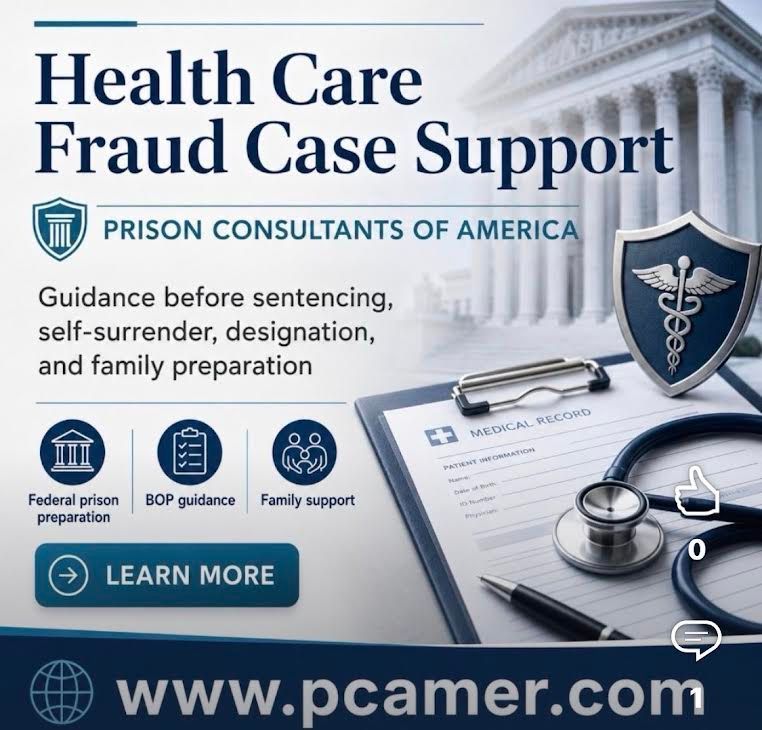
Federal authorities are continuing an aggressive nationwide effort to investigate and prosecute health care fraud, with 2026 producing some of the largest coordinated enforcement actions in recent years. In June, the U.S. Department of Justice announced its 2026 National Health Care Fraud Takedown, resulting in criminal charges against 455 defendants in connection with more than $6.5 billion in alleged health care fraud. The cases involve a wide range of alleged conduct, including fraudulent Medicare and Medicaid billing, durable medical equipment schemes, telemedicine fraud, identity theft, and the illegal diversion of controlled substances. (Department of Justice) The crackdown has not stopped with the national takedown. Federal authorities continue to announce new prosecutions, guilty pleas and major civil settlements. In August alone, enforcement actions included cases involving fraudulent hospice billing, Medicare Advantage claims and allegations involving hundreds of millions of dollars in false claims. (HHS OIG) For physicians, medical professionals and business owners facing a federal health care fraud investigation, the consequences can extend far beyond financial penalties. A conviction can result in substantial prison time, restitution, forfeiture and exclusion from participation in federal health care programs. At Prison Consultants of America, we understand that a federal investigation, indictment or conviction can be overwhelming for defendants and their families. Understanding the federal process—and preparing for sentencing, designation and incarceration as early as possible—can make an important difference in navigating what comes next. Prison Consultants of America provides prison consulting and federal sentencing-related support services. We do not provide legal advice or replace the services of licensed legal counsel.

Federal health care fraud enforcement continues to be a major priority across the United States. In June 2026, the Department of Justice announced its National Health Care Fraud Takedown, charging 455 defendants, including 90 doctors and other licensed medical professionals, in alleged schemes involving more than $6.5 billion in false claims. For physicians, health care executives, pharmacy owners, medical professionals and others who are convicted of a federal health care fraud offense, the consequences can extend far beyond sentencing. A federal prison sentence creates an entirely new set of concerns involving designation, self-surrender, classification, programming, safety, family communication and preparation for eventual reentry. Prison Consultants of America helps clients prepare for what comes next. Our work begins by helping clients and their families understand the federal prison process and what they can realistically expect. We assist with pre-incarceration preparation, self-surrender planning, Bureau of Prisons policies and procedures, designation and transfer issues, administrative remedies, available programming, First Step Act considerations and reentry planning. Professionals entering federal custody often have never experienced incarceration before. Preparation matters. Understanding the system before surrender can reduce uncertainty and help clients make better decisions from the first day of their sentence through their eventual return home. Prison Consultants of America is not a law firm and does not provide legal advice or promise sentence reductions, specific designations or other outcomes. We provide practical prison preparation, education and support based on the realities of the federal correctional system. Facing federal incarceration after a health care fraud conviction? You do not have to enter the system unprepared. Prison Consultants of America Federal Prison Preparation • Self-Surrender • BOP Guidance • Administrative Remedies • Reentry Planning

When a client is facing incarceration, the legal process does not end at sentencing. In many cases, that is when an entirely new set of challenges begins. From Bureau of Prisons designation and classification to facility placement, programming, release preparation, and family guidance, there are countless issues that extend beyond the courtroom. At Prison Consultants of America, we work alongside attorneys to provide practical knowledge and real-world guidance throughout the incarceration process. Our role is not to practice law, but to complement legal representation by helping clients understand what comes next and how to navigate it successfully. Attorneys trust us because we bring experience, professionalism, and a client-focused approach to every case. Whether assisting with prison preparation, Bureau of Prisons procedures, institutional adjustment, reentry planning, or supporting families during a difficult time, our goal is to provide information that helps clients make informed decisions and reduces uncertainty. A well-prepared client is often a calmer, more confident client. By partnering with legal counsel, we help ensure individuals understand the correctional system, know what to expect, and are better positioned for a successful transition both during incarceration and upon release. At Prison Consultants of America, we believe the strongest outcomes come through collaboration. Together with attorneys, we help clients move forward with knowledge, preparation, and hope. To learn more about how Prison Consultants of America partners with attorneys across the country, visit www.pcamer.com .

The Federal Bureau of Prisons recently reported that in one week alone, staff recovered 69 weapons, 418 grams of methamphetamine, and 383 cell phones from federal facilities. Those numbers should get people’s attention. For many individuals preparing to enter federal custody, there is a dangerous misconception that federal prison is predictable, easy to navigate, or somehow separate from the problems found in other correctional systems. The truth is that federal prison is still prison. Contraband, violence, pressure, investigations, and disciplinary issues are very real. Weapons inside a facility can quickly turn routine housing-unit tension into a dangerous situation. Drugs create debt, intimidation, and disciplinary exposure. Cell phones may seem harmless to some inmates, but possession or involvement with a contraband phone can lead to incident reports, loss of privileges, placement in the Special Housing Unit, transfer to a higher-security facility, or even new criminal charges. This is why preparation before surrender matters. A person entering federal prison needs to understand more than just where they are going. They need to know how to conduct themselves, who to avoid, what not to touch, how prison politics work, and how small mistakes can create major consequences. Families also need to understand the risks so they do not unknowingly become involved in prohibited communication, money issues, or outside pressure from other inmates. At Prison Consultants of America, we help clients and families prepare for the realities of federal custody. Our goal is to help individuals enter the system informed, focused, and aware of the decisions that can affect their safety, programming, release eligibility, and future. Federal prison is not something to figure out after arrival. The time to prepare is before surrender. Preparation matters. Awareness matters. Discipline matters. Visit www.pcamer.com to learn more.

The Federal Bureau of Prisons continues to face serious challenges as new leadership works to restore confidence in an agency that has been under growing scrutiny for years. Recent reports from both the Department of Justice Office of the Inspector General and the Government Accountability Office make it clear that the BOP’s problems are not new, and they will not be fixed quickly. Among the biggest concerns are long-standing structural issues, inconsistent implementation of important reforms, and ongoing problems with recidivism reduction efforts under the First Step Act. These findings highlight a difficult reality: meaningful change inside the Bureau will require more than promises. It will take sustained leadership, stronger oversight, better coordination with the Department of Justice, and continued support from Congress. For inmates, families, and attorneys, these ongoing problems matter. The way the BOP operates affects classification, programming, earned time credits, reentry preparation, and ultimately a person’s ability to successfully transition home. When leadership struggles to correct systemic issues, the people inside the system often feel the impact first. At Prison Consultants of America, we closely monitor developments within the BOP because these policy and management issues directly affect our clients. Understanding how the Bureau functions and where the challenges remain is critical for anyone preparing for federal prison, seeking First Step Act relief, or planning for reentry.
The latest reporting on Sam Bankman-Fried’s unsuccessful effort to gain traction for a presidential pardon is a reminder of something many defendants and families do not fully understand until it is too late: once a federal case moves beyond sentencing, the world changes fast. Politics, media appearances, public messaging, and last-minute influence campaigns rarely fix what should have been addressed early and properly. Recent coverage shows that Bankman-Fried’s push for support in Washington was met with open hostility, not sympathy, even as he tried to reposition himself politically. That matters because too many people facing federal prison still believe there is always one more move, one more connection, one more back-channel effort that can undo the damage. In reality, once a person is convicted and sentenced, options narrow. The Bureau of Prisons does not care about press spin. Other inmates do not care about public relations. And most people who enter the system unprepared learn very quickly that wishful thinking is not a strategy. Sam Bankman-Fried’s situation is high-profile, but the lesson is universal. A person can have money, access, lawyers, name recognition, media coverage, and people trying to help behind the scenes, and still find that none of it produces the result they hoped for. Reports over the past year have described his efforts to reframe himself publicly, including conservative media outreach and attempts to align himself with changing political winds, while the White House indicated no pardon was coming. For ordinary defendants, that lesson is even more important.
Fraud doesn’t just result in immediate financial loss—it can damage credit, drain savings, and undermine long-term financial stability for years. Beyond the personal impact, these crimes also erode public trust in technology and financial institutions. Simply put, the more we rely on digital systems, the more vulnerable we become. How to Protect Yourself: While no one is completely immune, taking proactive steps can significantly reduce your risk. Use strong, unique passwords and enable multi-factor authentication whenever possible. Avoid clicking on unknown links or downloading suspicious attachments. Regularly monitor your bank and credit card statements for unusual activity. Consider freezing your credit with all major bureaus, and always be skeptical of unsolicited calls, emails, or messages requesting personal or payment information. Awareness is often the first and most effective line of defense. The Bottom Line: Financial scams and identity theft aren’t isolated incidents—they’re a daily reality for millions of Americans. As technology continues to advance, so do the methods used by criminals. Staying informed, alert, and proactive is no longer optional—it’s essential for protecting your financial future.
When Doctors Cross the Line — Understanding Health Care Fraud Health care fraud is often associated with billing mistakes or administrative errors. But in the federal system, prosecutors focus heavily on cases where medical professionals intentionally defraud government programs like Medicare, Medicaid, TRICARE, or private insurers for financial gain. When a doctor crosses that line, the consequences are severe — criminal charges, restitution, loss of license, and in many cases, federal prison. What Does Health Care Fraud Look Like? Common schemes include: Billing for services that were never provided “Upcoding,” or charging for more expensive procedures than were performed Unnecessary testing, treatments, or prescriptions Kickback arrangements with labs, pharmacies, or other providers Fraud tied to opioid prescriptions or controlled substances Investigations are aggressive. Federal agencies — including the FBI, IRS-CI, HHS-OIG, and DEA — can spend months or years building a case before making any contact with the provider involved. Why It Happens Pressure within the healthcare industry is real: declining reimbursements, administrative costs, and complex billing systems. Unfortunately, some physicians respond to financial strain by cutting ethical corners, and others get drawn into schemes by consultants, marketers, or pharmaceutical reps promising quick revenue. But intent matters. A legitimate billing error is not a crime. Fraud is. When a Doctor Faces Federal Charges Once a provider becomes a target, the process moves fast: Investigation/subpoena Indictment Plea negotiation or trial Sentencing and potential prison designation At sentencing, courts consider restitution, cooperation, patient impact, and acceptance of responsibility. Many first-time, white-collar defendants are shocked by how quickly their professional reputation, livelihood, and freedom can collapse. If you or someone you know is under investigation or facing sentencing for a health care fraud case, preparedness matters. Understanding the federal process, the Bureau of Prisons (BOP), and the options regarding custody, programs, and potential early-release opportunities can significantly impact the outcome. Prison Consultants of America (PCA) works with individuals and legal teams nationwide, helping clients navigate these challenges with clarity and strategy.
Nationwide Support | Quietly Professional
Prison Consultants of America LLC
Home Office
332 S. Michigan Ave
Chicago, IL 60604
Serving clients nationwide, including:
Los Angeles •
New York •
Dallas •
Tampa
Call Us: (800) 847-6160
Email Us: info@pcamer.com